
5 Machine Learning in Trading Secrets: Powerful Wins & Critical Failures (2026)
The application of machine learning in trading models is transforming the way traders interpret their data, forecast changes and automate their decisions. Starting with mere regressions, progressing to neural nets, ML offers a competitive advantage, but with far more potent shortcuts, such as overfitting and market intricacy.
This article is a simplified dissection of the same to people of India, UK, and the US, including real-life situations and the warnings of experts. The trading strategies of AI 2026 are putting the system into the charge as traders refine their mentalities towards financial markets.
What Is Machine Learning in Trading?
Machine learning in trading is the artificial intelligence algorithm applied to the market data to detect patterns and make an autopilot-trading decision. As compared to conventional methods that are based on set rules, ML systems gain experience based on data collected in the past and evolve to suit the evolving market trends.
Consider it a tireless officer that processes a million data points a second, sees patterns that cannot be identified by the naked eye and makes trades in seconds.
How Does it Actually Work?
Machine learning models process huge volumes of data such as:
Detailed (OHLCV) historical price data.
Volume trading over various periods of time.
News and social media sentiment of the market.
Economic data and indicators.
Alternative sources of data (satellite images, web traffic)
Such models would then recognize favorable trends and produce trading patterns to direct you on when to sell, buy or to hold one or the other position.
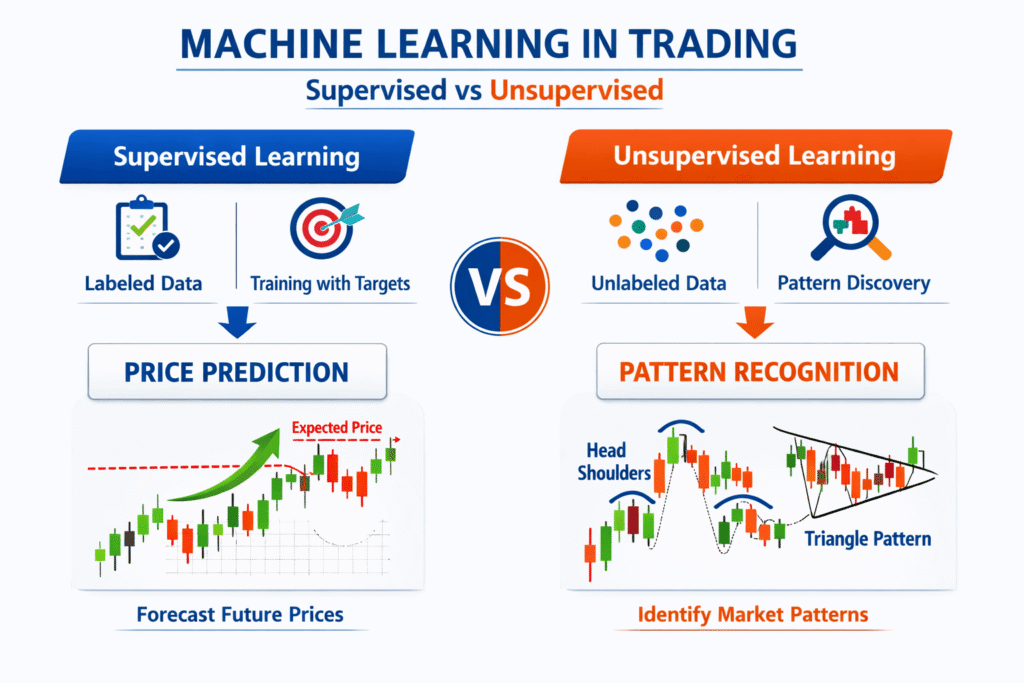
🤖 Supervised vs Unsupervised Learning
✅ Supervised Learning
Supervised learning is a technique that involves the use of labeled historical data in order to get predictions. You feed the algorithm with examples of which you are sure of the result.
Training of trains on labeled data – historical prices where the results are known (e.g. price up, price down). The model acquires input-output relationships. Available in classification (trend direction) and regression (price prediction).
Real Trading Example: Suppose that you have a 5-year old Apple stock data model. You call one day buy (when price rose the following day), and call one day selling (when price dropped). The algorithm learns tendencies which were followed by profitable moves.
Examples include:
Linear regression
Random forests
Support vector machines
🔎 Unsupervised Learning
Unsupervised learning is the identification of non-identified patterns in data, without any information of what to seek.
Makes inferences on unlabeled data to identify latent structure – such as clustering of like market regimes, pattern segmentation or anomaly detection. Fine in shifting regimes and regime based entry regimes.
They both are vital in varied trading processes.
Real Trading Example: A clustering algorithm takes into analysis thousands of stocks and automatically clusters them based on their behavioral patterns. You may also find that some of the technology stocks go in tandem under certain market conditions- which they can utilize to pair trade.
🚨 Why Most Traders Fail With ML (The Brutal Truth)
In general, why most traders lose with ML (The Brutal Truth)?
Studies indicate that 90 percent of retail traders who adopt machine learning approach go bankrupt. Here’s why:
Critical Failure Reasons:
Insufficient Data Quality ❌
Working with free data gaps and errors.
Failure to take into consideration survivorship bias.
Excluding corporate actions (splits dividends)
Over-Optimization ❌
Fine-tuning with the backtests to appear flawless.
It involves repeated testing on the same data.
There are no transaction costs and slippage.
Lack of Domain Knowledge ❌
Ambiguous models of world-building.
Disregarding the core economic aspects.
Failure to identify the changes in market regimes.
Unrealistic Expectations ❌
Expecting 100%+ annual returns
Trade in capital inadequately.
Failure to consider drawdown periods.
Poor Risk Management ❌
No stop-loss mechanisms
Over-leveraging positions
Lack of diversification of strategies.
Experienced Warning:
The greatest error that I can see is when traders apply ML not knowing WHY a pattern exists. In your model you may notice that on Tuesdays there is an increase in stocks, however since there is no reason that is supported, then that will not continue. The question to ponder on is: is this economically viable?
Price Prediction vs Pattern Recognition
| Task | Goal | Example |
|---|---|---|
| Price Prediction | Estimate future value | Predict next day closing price |
| Pattern Recognition | Identify recurring structures | Find head-and-shoulders or volatility clusters |
Price prediction is harder in markets because financial series are noisy and non-stationary. Pattern recognition helps signal structure, but prediction aims to forecast magnitude and direction.
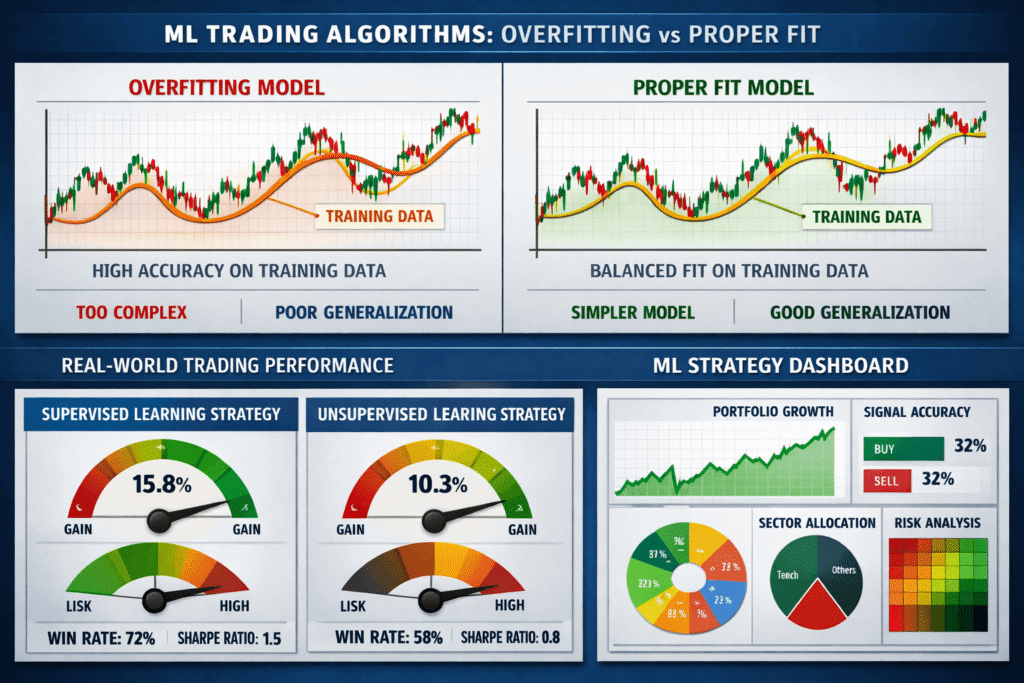
Overfitting — Explained Simply
The problem of overfitting occurs when a model memorises the historical noise rather than learning true patterns. This will give fantastic backtests and a poor live performance.
Now just consider this: You fit a model this strictly to old data that it forecasts the past excellently–but it crashes miserably at the present. This constitutes a colossal risk in the trading techniques.
Simple signs of overfitting:
✔ Model Great on training, poor on validation.
✔ Predictive performance fails on novel data.
Fixes:
✔ Champion cross-validation (e.g. purged cross-validation of time series)
✔ Relativism characterized by sample size.
✔ Walk-forward analysis
🚀 Take Action: Start Your ML Trading Journey With StealthX
Ready to harness machine learning in trading the right way?
StealthX provides:
✅ Pre-built, tested ML trading models
✅ Automatic overfitting detection
✅ Real-time pattern recognition across 1000+ assets
✅ Risk management tools that protect your capital
✅ Educational resources from experienced quants
Exclusive Offers:
📱 Join our Telegram Community: Get daily ML trading insights, strategy updates, and connect with 5,000+ successful traders Join StealthX Telegram
📺 Subscribe to Our YouTube Channel: Watch detailed ML strategy breakdowns, live trading sessions, and tutorials Subscribe Now
💰 Join Our Affiliate Program: Earn 10% commission on every trader you refer. Perfect for educators and influencers Start Earning Today
The Future is Intelligent Trading
Machine trading AI is not a silver bullet: it is a potent tool, and one that needs wisdom, training, and unrealistic goals.
The successful platforms and strategies integrate the state-of-the-art AI with human expertise coupled with risk management. It does not matter whether you are a total newbie or a seasoned trader, the important thing is to start with tried and tested systems such as StealthX where you are not subjected to the usual trappings as you learn.
It is not the question of whether AI will rule trading but the reality is it does. The question is: will you make it within the 10% that make profits off it?
Intelligent Trading Start trading with StealthX today.
At StealthX:
🔸 We offer pre-built features and risk screens.
🔸 Data-driven signal pathways.
🔸 Practical models with ongoing validation.
Best Practices:
- Start with simple supervised models (regression trees, SVM)
- Validate on unseen data
- Use pattern recognition as filters
- Avoid over-complex neural networks without enough data
- Integrate risk metrics into every strategy
Pingback: AI Trading Strategies 2026: Essential Tactics, Real Use Cases & Alarming Pitfalls